Wednesday, September 1, 2010

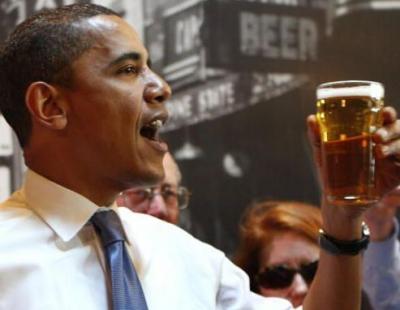
Barack's Big Beer Bets


Following the United States' loss to Canada in the 2010 Winter Olympics ice hockey finals, President Obama settled a friendly wager with the Canadian Prime Minister, sending him Molson with a little taste of America--a case of Yuengling--to go along with it. A few months later, he made a similar bet with British Prime Minister David Cameron over the World Cup game, but it ended in a draw. Sadly, both leaders stayed dry.

I can really appreciate a president who enjoys his brew. And a beer-loving Commander in Chief should come at no surprise given the fact that many of our Founding Fathers brewed beer. Some even developed their own original recipes. So next time you pledge allegiance, make sure you hold a cold one to your heart; beer is as tied up with our American heritage as the Star-Spangled Banner.

...

If you want my opinion, I think that a few cases of Arrogant Bastard would have sent a more powerful American message. Next time, mayhap.

Tuesday, August 31, 2010

Fried Beer!?

I was once at a party where a man was frying Snickers bars. This new innovation at once confused and delighted me, so I approached the man as he battered another bar with a thick, syrupy concoction. I pried with great interest:
"What other types of things can you fry?"
"Anything."
The man responded with terse confidence, a smug grin creeping across his face as he continued to busy himself with his craft. A mere moment later, empiricism got the best of me, and I returned to demand proof.
"What about Cotton Candy?"
Now the gauntlet was thrown down, and, predictably, he took up my wager with a cocky smirk.

I handed him a large ball of cotton candy I had procured on approach, anticipating his acquiescence to my friendly challenge. Despite my initial incredulity, I actually I did want to believe that, indeed, you can fry anything. It's the pipe dream of all Southern food-lovers. And his own confidence inspired hope in me.

However, within minutes, despite attempts at containment, the ball of cotton candy had mostly dissolved into his batter. The goopy mixture was subsequently transferred to the fryer, dripping with futility, reduced to almost nothing. The loose aggregate of brown and pink sunk into the burbling oil like a wet blanket, and the resulting victual resembled a piece of fried chicken skin flecked with pink sprinkles. It tasted like crispy sugar-butter, like batter, like shattered dreams. I considered the experiment a failure and went away somewhat disheartened at the revelation that there were indeed pragmatic limitations to what we can fry. Was this it? Had we fried all there was to fry? These questions burned with their pitiful finality, and the epistemic claustrophobia engendered thereby would haunt me to this today.

But, lo! What new culinary miracle hath science wrought? Well, friends, we've put a man on the moon, conquered disease, connected the globe, de-crusted peanut butter and jelly sandwiches, and finally, we've fried beer.


That's right. Fried beer. It's injected into a pocket of pretzel-like dough, deep fried, and served up for your (adult) enjoyment. I'm confident that we've hit the ceiling in terms of ground-breaking discoveries. Science, you can retire.

Sunday, August 22, 2010

The Quest for Sour Ales (and others)

Last year's Great Taste of the Midwest for me could easily be summed up with one word: hops. It was all about finding the hoppiest IPA out there, and it certainly took a heavy toll on my palate.

This year, however, was all about finding the ultimate sour beer. My affinity for tart ales takes me back slightly more than a year ago to Buffalo, NY, at the Brewing News headquarters. In the middle of one of our usual "beer and cheese" breaks, my boss pulled out a bottle of New Glarus Berliner Weiss, part of their 'Unplugged' series. I tilted my glass back and drank...it was highly carbonated and very, very tart. Honestly, I had never had anything quite like it. From that moment on, I was hooked. This newfound love was only exacerbated when, a few weeks later, I had Ommegang's phenomenal Flemish red ale, Rouge.

Anyways, that's the background as to why I was really shooting for the mouth-puckering brews at this year's fest. I walked through the entrance around 10:30 and picked up my media pass--I was helping cover the event for the Great Lakes Brewing News, one of our seven regional papers. I spent the first half hour walking around, scoping out the brews and finally made a choice...Tyranena's Double Down and Dirty Stout. Thick, rich and full of chocolate, it was the best stout I had all day (yes, even better than Dark Lord and the E.T.'s Reese's Pieces). Oh, and the best part? It was only available to those who got in before 1pm (aka media, volunteers, etc.).

Oh wait, I'm supposed to be talking about sour ales, aren't I? Kudos to Lakefront Brewery for tolerating my persistent returns to their booth--the beer I was in search of was Rosie, which they were having trouble getting tapped due to a severe lack of ice (a number of breweries were having this issue). Once they got it working, I was in heaven. Highly carbonated with wonderful cherry notes, this beer has been a standout since I visited their booth at Quivey's Grove last October. After having my Rosie fix, I sauntered over to Bell's tent, where I had another superb sour--Wild One. I find the combination of tartness and cherries to be completely complimentary, and this was no exception. The beer was excellent and I had to get a refill once I was done with the first glass.

I made my way over to Jolly Pumpkin, a Michigan Brewery known for their exceptional Belgian Ales, and particularly the sour ones. I had never had their Kriek before, so naturally, it was the first one I tried. Yet another sour brown combined with...cherries, it was incredible. It was the third brewery I visited, and sour ales had yet to fail me. At 1pm, Tyranena released 'Deb and Glenn's Kinda Lambic', aged in bourbon barrels. A brown ale fermented with [at least] three different kinds of fruit, it was awesome, and I let their owner Rob Larson know the following night when I was fortunate enough to join him (and my boss) for dinner. Sidenote: My boss, William Randolph Thirst (also known as "Bill Metzger") accomplished the rather incredible feat of securing a keg of Bitter Woman IPA for my aunt's upcoming wedding. Well done, seriously.

Finally, I made my way over to the Real Ale tent, which I was sure would have a number of sour, mouth-puckering brews. My first choice was Jolly Pumpkin's Oak-aged Calabaza Blanca with Hibiscus. It was absolutely phenomenal and extremely refreshing. The Hibiscus apparently adds additional aging to the beer, helping with the tartness. My second beer was Kuhnhenn's two-year aged Geuze. And, without a doubt, this was my "Beer of the Fest." They combined the two-year aged beer with fresh sour ale, and the result was absolutely astonishing. I kept count on how many times I had my glass refilled with the geuze, and the number was a mildly-insane...7. The keg was eventually completely empty around four o'clock, and I was more than happy to contribute!

This year's Great Taste of the Midwest was absolutely wonderful. I had many, many beers in all kinds of styles, but for me, this year's was all about the sours...and they did not disappoint. In fact, sour ales may have taken over the infamous IPA as my #1 beer style, although I suppose only time will tell. Next up on the calendar is Quivey's Grove, which takes place the first weekend in October. Will I have a new style and beer quest? Stay tuned to find out!

Monday, August 16, 2010

The Great Taste of the Midwest

Aside from her natural beauty and that je ne sais qoi charm, Madison plays host to the second largest beer festival in the U.S.: The Great Taste of the Midwest. This year, five gigantic tents and a few satellite cabanas housed over 120 breweries serving some 500 beers from 11 Midwest states.

The party began at 1:00 p.m. on Saturday in Olin Park, about a mile from the Capitol building. The din of 3000 bon-imbibants melded with the music from the folk and bluegrass bands scattered among the tents, providing a carefree, jovial soundtrack for the full five hours of drinking. Even the sun decided to make an appearance late in the day after severe negotiations with heavy, gray clouds. Not even Helios himself would miss the Great Taste.

Ales were so in this year. Belgian Ales and IPAs seemed to predominate, though emissaries from every style were poured with wild abandon. A "Real Ales" tent was devoted specifically to cask-conditioned, unfiltered ales served at cellar temperature. Instead of being pumped from a conventional beer engine, they went ultra-old-school and used gravity for pour power. To expedite the serving process, each cask was marked with a number. You'd hand over your glass, bark out a number, and a server would quickly disappear to fetch your beer from the racks like a crazed librarian on a search for the public library's last copy of Twilight at the behest of a bawling tween needing her fix. I'm sorry; I lost control of that metaphor, and I apologize for anyone hurt in the process.

The "Real Ales" tent was real tasty all right, but the real action was at the Brewers' tents, where current inventory, special releases, SWAG, and merch were all up for grabs. The festival's program featured a map and key for navigation purposes, allowing us to easily locate our old standbys and promising candidates. Strategy is key. Here's your chance to talk to the brewers a bit, make some banter in line, and get a feel for what a brewery is all about. You can't waffle and dither and temporize with your crippling indecision. This isn't for petal pickers and nail biters. Choosing a brewery and specific beer after an arduous deliberation process can lose you valuable time, and you'll leave with a head full of regrets and a bloodstream full of sobriety. Thus, taking time to review the program before a festival will help maximize your experience. Fortunately, I just consulted with Dylan, who, possessing a media pass, was able to initiate the drinking process 2 hours before everyone else. His advise enabled me to hit the all-stars immediately before they became too popular (and before the alcohol/hops tempered my tastebuds). So, like many successful men before me, I simply had to stand on the shoulders of Jews. I mean giants.

Still, you don't need to be Eddie Carmel with a Magellan GPS to find your way around a beer festival. Most breweries had some great offerings. The crowd favorites--Bell's, Founders, Goose Island, Three Floyd's--took to the field with their predictably impressive selections on tap. I had a quasi-"Saint Theresa" moment during the 2:30 p.m. release of Three Floyd's 2008 Dark Lord. It can best be described in one word. However, I generally tried to avoid the usual suspects, given my familiarity with them. I was in the business for something new and possibly a little crazy. Thankfully, a few new faces were able to knock me out with their consummate stylistic renditions and, in some cases, heretically unorthodox recipes.

A beer festival's quality indicator is incontrovertibly a long line, and one particular brewery had a disproportionately huge brew queue. As many as 30 people waited patiently behind this brewery's table while other brewers' taps sat forlorn and idle nearby. Obviously, there had to be a reason for this gravitation, so I, too, waited in line with baited breath just to see what this hubbub was all about. When lips finally touched liquid, I knew that this was the festival's MVP. So, ladies and gentlemen, I now present to you, the blue ribbon winner at The Great Taste of the Midwest, Kunhenn Brewing Co LLC.

Kunhenn's, a microbrewery from Michigan, is owned and operated by the Kunhenn brothers (families really know how to brew; just ask Three Floyds). They bill their brews as "Out of This World," adopting a little green alien as their mascot. Their approach to beer can be best described as weird, wet, wild, and fun...with a dash of sophistication.

Kunhenn's distribute locally in Michigan out of a brewpub which carries their wine, mead, and an outstanding array of craft beers. They offer classes for brewing a batch beer or making wine on premise, enjoining their customers to not only get a fish, but learn to catch one as well. Their ascendancy in the Michigan Craft Beer scene owes to unbridled inventiveness and a fantastic assortment of great-tasting beers that draw loyal followings. Speaking of beers, here's where we start the crazy talk.

ET's Reese's Pieces Stout. Inky black with a dark, sand-dune head, this strange brew's peanut-buttery-chocolate nose perfectly replicated the scent of my roommate's Reese's Puffs cereal I had eaten that very morning. The taste was akin to Hershey's chocolate syrup with suggestions of coffee, leaving the peanut butter component to your olfactory glands only. It was heavy, and delicious, and weird. Love at first sip. Oh, I almost forgot: to top off the whole experience, they dropped dry ice pellets onto beer's head, releasing an eerie white mist. Drinkers emerged from the tent with what seemed like the extraterrestrial nostrum from a Star Wars apothecary.

Alien Ale. A pepper beer infused with three different kinds of pepper. While not as gentle as The Grumpy Troll's Slow Eddy or as aggressive as Great Dane's Tripepper Pilsner, it's a fresh mouthful of jalapeño that answers the question: ¿Que?

Creme Brulee Java Stout. Can life get any better? 4 out of 5 optimists say "No." I did not try this beverage, as the keg was kicked half-way through the festival, so I have no authoritative comment. But, c'mon. Beer + Creme Brulee + Java = ridic. The fact that it ran out so quickly is sufficient testimony to its awesomeness.

In short, Kunhenn's is breaking the rules in all the right ways. More beer reviews may be forthcoming, potentially in a podcast. I just had to comment on the highlights of the day. Next year, I urge you to drive, fly, or flubber out to Madison for the 2011 Great Taste of the Midwest. With so many beers and beer lovers in one place, you're bound to find your Happy Place. Peace ya'll.

Friday, July 16, 2010

Get Your Knowledge On

Perfect for the casual quaffer, the burgeoning beerthusiast, and the elite epicurean alike: click here to learn all about beer!

Thanks for the blog fodder, Kara!

Saturday, July 10, 2010

Lager v. Ale

Ah, the age-old debate between beer types. A rivalry drenched in blood and steeped intrigue. Well, ok, so the differences between them probably never manifested in some sanguinary battle or even bad blood, but Lagers and Ales are two very different animals and offer very different gustatory experiences.

Before we delve into beer arcana and probe the limitless depths of the LvA debate, let's wax historically.

The world's greatest minds generally agree that beer arrived fashionably late in human evolution somewhere around 9000 B.C. (based on context clues) or 3500 B.C. (based on chemical evidence). Whatever; it's old.

To be sure, the Babylonians definitely got crunk. Beer gets a shout-out in the Code of Hammurabi (c. 1750 B.C.), which prescribed a hearty ration of beer to the good drinker and a particularly ironic drowning regimen to the bad brewer:

108. If a tavern-keeper (feminine) does not accept corn according to gross weight in payment of drink, but takes money, and the price of the drink is less than that of the corn, she shall be convicted and thrown into the water.


The contemporary conception of beer--a blessed, boozy trinity of hops, barley, and water--did not strike the ancients as particularly intuitive. Brewers throughout history have used various recipes incorporating fruits, herbs, honey, and various adjuncts in order to produce a panoply of quaffable products. Grapes, honey, and saffron can be found in Dogfishhead's Midas Touch, which is a throwback to 2700 BC--it's brewed from a recipe found in King Midas' tomb.

While yielding a viable product with plenty of nutrients, taste, and inhibition-lowering potential, these ancient recipes lacked a key ingredient. I saw on a History Channel special that shelf-life was generally about a week or so. This wouldn't do. As the perfect alternative to fetid, contaminated well water, beer needed something to keep it from expiring so quickly. In the 1500s, hops become a potent preservative, thanks to innovative German monks and their dedication to beer. While on Lenten fasts, monks fortified their diets with hearty helpings of duds, establishing them as some of the most experienced craftsman in the art of brewing. Indeed, to this day, seven monasteries produce the world's only true Trappist style ales.

Sometime during the Middle Ages, a schism in the beer kingdom began to avail itself. Two beer types diverged and proliferated and went on to garner distinct and very unique identities. The rift wasn't a matter of graven images or contract theory or a bunch of theses nailed to church doors, just a tiny little microorganism called yeast.

Ales

The word Ale might instantly summon images and memories of India pale ale (IPA), the hoppy, bitter, and more alcoholic beer that you either love or hate. However, Ale's phylogenetic tree is vast and diverse, encompassing a gallimaufry of styles like:

Altbier- a German beer with medium to high bitterness without too much else to write home about.
Brown Ale- a British beer with hardly any bitterness, a generous amount of sweet maltiness
Lambic- a Belgian sour beer made from large amounts of unmalted wheat with a complex fruity palate
Stout- an Irish version of Britain's Porter style (also an ale) made from roasted malt, typically associated with heft, coffee, chocolate, and men.
Wheat Beer- German beers made with lots of wheat malt that go down great; best served in a boot.

Ales are top-fermented, meaning that the yeast sits at the top of the fermentation vessel and most of the fermentation happens here. They're typically fermented at warm temperatures (59-75 degrees F) anywhere from 3 weeks to several months. Due to the warmth of the brewing environs, ale yeasts kick out a lot esters, which are compounds typically associated with flowery and fruity tastes. Esters are super complex, which helps explain why ales are so varied and discernibly different in taste, smell, and mouthfeel.

Notable yeast strains used in ale brewing include Saccharomyces cervisiae and, to a much lesser extent, Brettanomyces. Brettanomyces is used in only a few styles, such as Lambics, because it's actually a contaminant, a wild yeast strain that can lend a band-aid or barnyard-like taste to the beer. However, it also has some counterbalancing virtues, like infusing the beer with hints of bacon, spice, and clove that make Lambics so unique. Want to rate your favorite strain of Brettanomyces? Go here, ya geek!

Lagers

A Lager can be defined as a beer brewed at cooler temperatures with yeast at the bottom. "Lagering" might not be prevalent in your everyday vernacular, but it refers to the cold storage of beer (Lager is German "to store"). Lagers emerged late on the scene in history. The invention of refrigeration enabled brewers to capitalize on a finicky, genetically mutated Saccharomyces species that worked well in low, stable temperatures. While Lager yeast requires more attention (even a 1 degree change in temperature during fermentation can drastically alter taste and alcohol content), it opens up a portal to an entirely new realm of beer drinking.

Lower-temperature fermentation yields less esters and phenols, leading to a reduction in fruity notes and medicinal tastes. Drinkability is not only the slogan of a popular pale lager (cough, Bud Light, cough), it's the reason why so much lager is consumed at Oktoberfest and Nascar. Lagers can be drunk by the gallon, whereas the palatial complexity of ales make them great companions to the steady, appreciative drinker.

A colder beer also means more dextrins. These are the unfermentable components of the malt that imbue the beer with added mouthfeel and taste. If you're like 90% of America that drinks lager beers, you're probably not used to these characteristics, having grown up with Natty Light and Bud Light. But one swig of a big-bodied, cloying Doppelbock will have you quickly doubting its relation to Miller, Budweiser, and Coors products.

While we're on the subject, let me call out some of the great Lager styles

Bock- a strong, russet-colored, German beer with toasty notes and plenty of heft (about as close to liquid bread as lagers come).
Eisbock- a subgenre of Bock, the Eisbock is created when a bock is cooled down so that ice crystals begin to form (freeze distillation). These are then scooped out, yielding a more concentrated beer (in taste and alcohol). Ever heard of Natty Ice? It's an Eisbock. Don't start to cast aspersions on a very regal beer style...we'll call Natty Ice "The prodigal son who'll never return."
Malt Liquor- Surprised? Due to some technical definitions, any lager with more than 5% alcohol should be called Malt Liquor.
Pilsner- a Czech beer with medium bitterness, medium body, and full flavor

So that's the beer world according to a Manichaean. Lagers and Ales. But the fun doesn't stop here. As I indicated, the styles of lagers and ale are virtually limitless, and the diversity of tastes within these genres is readily discernible. Scientists have isolated over 1000 distinct flavors in beer, which is way more then wine. And the tastes will continue to diversify, with brewers like Dogfishhead adding essences, extracts, and whole foods into their brew kettles; scientists cross-pollinating different species of hops to unleash new strains into the market; and breweries continually tweaking and revamping the brewing process. This is a good era in which to live.

The vibrancy and innovation of the beer industry has engendered an affordable and versatile product befitting of every taste under the sun. Maybe that's why, every year, the world drinks enough beer to fill 60,000 Olympic-sized swimming pools. I've written this article by looking at beer from 36,000 feet--breaking it down into simply Lagers vs. Ales--so that you can hopefully make the first step towards finding your preference. Get adventurous. Beer is unique, beer is vital, and beer is good.

Sunday, June 6, 2010

Rants and Raves, Vol. 1


Instead of talking about news in the brewing industry every week, I thought it would be a bit more entertaining to do a weekly post where I talk about what I've got a problem with in the brewing industry, and follow it up with something more positive. Anyways, time to start it off:

Rant: Miller Lite and their ever-evolving ways of tricking the average consumer into purchasing their shitty beer. First, they came up with the fraudulent "triple-hopped" logo, failing to mention that all beers are essentially hopped at least three times throughout the brewing process. Unfortunately, the corn and rice they add as filler into their beer doesn't help the taste. Now, they've come out with their new "vortex" bottle, which is simply a bottle that twirls the beer as it pours out. Does it add anything to the taste? No. Does it release more aroma? No. So, what exactly does it do? Well, it gives the bottle a new design, which I suppose looks sort of cool, if you're into that sort of thing. The only way I want my Miller Lite is ice cold, so I don't have to endure its urine-like flavor.

Rave: Now, switching over to something more positive--Belgian IPAs. Stone and Victory started this trend about a year (maybe a bit more) ago with their Belgique IPA and Wild Devil, respectively...it's essentially an IPA with added Belgian yeast. Hooray, experimentation! The style has truly taken off, and for those of us who are true hopheads, it's a welcome-addition to the IPA family. Wild Devil is one of my favorites, but Ale Asylum's Bedlam has skyrocketed to the top of my list as well. The beer has a really nice, fresh hoppy flavor to it, along with a backbone of yeasty-goodness. Here are five Belgian IPAs I consider must-haves:
  1. Stone Cali-Belgique
  2. Victory Hop Devil
  3. Ale Asylum Bedlam
  4. Green Flash Le Freak
  5. Flying Dog Raging Bitch (hey, I didn't come up with the name)
That's it for this week's Rants and Raves--join us next time, when I find something new to complain (and praise) about!